

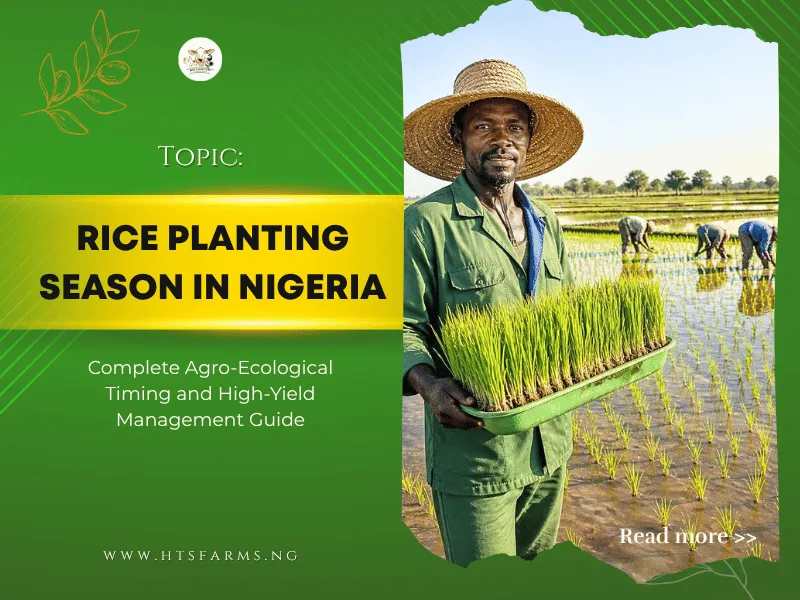
- Rainy Season Sowing Windows: Rice planting in Southern Nigeria starts from mid-March to mid-April after two to three steady rains, while Northern Savannah belts plant between early and late June.
- Dry Season Irrigation Schedules: Dry season rice farming begins in November through January, requiring continuous water pumping before hot March temperatures arrive.
- Seed Rate Guidelines: You need 40 to 50 kg of seed per hectare for upland dibbling, 50 to 60 kg per hectare for lowland transplanting, and 80 to 100 kg per hectare for broadcasting.
- Fertilizer Split Applications: Apply 4 bags of NPK 15:15:15 at planting or final land preparation, then top-dress with 2 to 3 bags of Urea at 5 to 8 weeks after sowing.
- Paddy Yield Potential: Improved seed varieties produce between 4 to 8 tonnes per hectare (53 to 106 bags of 75 kg paddy), compared to traditional landraces yielding under 2 tonnes.
- Critical Weed Control Windows: Apply pre-emergence herbicides within 2 to 3 days of sowing and post-emergence selective sprays at 2 to 3 weeks to prevent yield loss.
Growing rice successfully in Nigeria comes down to one golden rule: matching your planting date with the exact moisture patterns of your ecological zone. Rice is like a thirsty baby that drinks water every day; if the water stops before the grains fill up, the entire farm produces empty husks. Knowing the exact planting season in Nigeria protects your investment from mid-season droughts, flash floods, and severe weed outbreaks.
Whether you farm on well-drained upland soil, river valleys (Fadama), or engineered irrigation schemes, your calendar determines your final grain weight. Let us break down every stage step-by-step so you harvest maximum bags this season.
What Month Do You Plant Rice Across Nigerian Agro-Ecological Zones?
The primary rice planting window in Nigeria spans from May 15 to July 15 for rainfed savannah regions, and March to April for southern rainforest belts. Rice grains require warm soil temperatures of at least 20°C to germinate evenly and establish strong root crowns. Planting too early exposes young seedlings to false rains, while planting too late exposes flowering panicles to early dry spells.
I always advise farmers to monitor local rainfall rather than sticking blindly to a single calendar date on paper. A reliable rule of thumb is to sow only after receiving two to three heavy, soaking rains that keep the topsoil moist for consecutive days. This initial moisture reservoir allows the seed embryos to swell, push out vigorous taproots, and outgrow dormant weed seeds.
When planning your farm calendar, match the maturity duration of your rice variety to the length of your region's rainy window. Short-duration varieties need at least 90 to 100 days of soil moisture, while medium-to-late varieties demand up to 135 continuous wet days. Missing this alignment leads to poorly filled grains and severe yield drops.
| Agro-Ecological Zone | Wet Season Sowing | Dry Season Sowing | Primary Harvest |
|---|---|---|---|
| Southern Rainforest | Mid-Mar – Mid-Apr | Nov – Dec (Fadama) | Jul – Aug / Dec |
| Southern Guinea Savanna | Early – Mid June | Nov – Jan (Pump) | Oct – Nov / Apr |
| Northern Guinea Savanna | Early – Mid June | Dec – Jan (Canal) | Oct – Nov / May |
| Sudan / Sahel Belt | Late June – July | Dec – Jan (Bore) | Oct – Nov / May |
When is the Best Time to Plant Rice in Southern Forest and Derived Savanna?
In the Southern Rainforest and Derived Savanna zones (such as Ogun, Ondo, Edo, Delta, Enugu, and Ebonyi), the best time to plant rainfed rice is from mid-March to mid-April. These zones experience an early onset of rains, allowing farmers to establish an early wet-season crop before the heavy July downpours arrive.
Early land clearing must begin between November and February so that plowing and harrowing coincide with the very first showers of the year. Plowing early buries residual weeds and converts them into rich organic compost before seeding begins. This practice provides your baby rice plants with loose, fertile soil to anchor their roots quickly.
Farmers in the south who plant by early April often harvest their main crop between July and August. This swift turnaround allows you to take advantage of high market prices before the massive northern harvest floods the commodity markets later in November. It also creates room to plant a second short-duration upland crop on the same field.
However, you must prepare for the August dry spell, commonly called the "August Break" in southern Nigeria. If your rice is flowering during this two-to-three-week dry stretch without supplementary moisture, the flowers dry up and produce empty grains. Choosing early-maturing seeds like Seed Co FARO 44 Rice Seed ensures your crop finishes flowering before the dry break starts.
Make sure your farm drainage channels are cleared before the peak rainfall of September arrives. Excess standing water on non-swamp fields can drown young upland rice stands and cause severe root rot diseases. Good soil conservation bunds along natural contours will hold just the right amount of water while draining off destructive flash floods.
When is the Rice Planting Season in the Guinea and Sudan Savanna Belts?
In the Southern and Northern Guinea Savanna (including Kaduna, Niger, Benue, Taraba, and Plateau states), the optimal planting period falls between the first and second weeks of June. In these belts, rains become stable and continuous by early June, providing the deep soil saturation required for rapid seed emergence and active tillering.
Further north in the Sudan Savanna belt (covering Kano, Sokoto, Kebbi, Katsina, and Jigawa states), plant during the third and fourth weeks of June. The rainy season in this semi-arid belt is much shorter, usually lasting only 75 to 100 days. Sowing during late June ensures the crop hits its peak vegetative and reproductive stages during the heaviest rains of July and August.
Never sow rice in the savannah before the rains are fully established, even if an isolated heavy storm falls in late April. Savannah soils are often sandy or gritty, meaning they lose surface moisture rapidly under high sunshine, which will scorch tender germinating shoots. Wait patiently until the subsoil is thoroughly wet before drilling your seeds.
Savannah farmers must select fast-growing, drought-tolerant varieties to avoid crop failure when rains end abruptly in September or October. Planting certified FARO 67 Rice Seeds 25kg gives your crop rapid seedling vigor and excellent drought-escape capabilities, protecting your grain yield against erratic end-of-season rains.
Always clear tree stumps and level your savannah fields properly during the dry months of February and March. A flat, well-leveled seedbed distributes rainfall evenly across all stands, preventing dry patches on elevated spots and avoiding waterlogging in deep ruts.
How Does Dry Season Fadama and Irrigated Rice Planting Timing Work?
Dry season rice farming, commonly called irrigation or Fadama farming, runs from November through April, completely free from the risk of rainy-season flood disasters. The optimal window to establish your dry-season nursery is between late November and mid-January, transplanting seedlings into bunded field basins within 21 days.
Irrigation rice farming gives the highest grain yield per hectare because crops receive continuous, intense sunlight without cloud cover. Rice plants convert direct sunlight into heavy food reserves, provided their root systems are kept submerged in 3 to 5 cm of clean water throughout the growing cycle.
The biggest environmental hurdle during dry-season planting is the cold harmattan wind that blows from December to early February. Cold water and low night temperatures can stunt young rice seedlings, turn leaves pale yellow, and slow down vegetative development. To protect your nursery, flood the beds in the evening to retain ground warmth overnight, then drain excess cold water in the morning.
Transplanting must be completed before late January so that your crop flowers during warm, sunny February and March days. If planting is delayed into late February, the extreme dry heat of April can scorch pollen grains, leading to high spikelet sterility and empty panicles.
Reliable water pumping systems are compulsory for dry-season success. Ensure your water canals, tubewells, or river intake pumps are fully serviced, fueled, and tested before moving a single seedling from the nursery to the main production basins.
How Do Upland and Lowland Ecologies Determine Your Rice Farming Method?
Lowland swamp ecologies (inland valleys and river floodplains) retain standing water for 4 to 5 months, making them ideal for heavy-yielding, long-duration varieties. In contrast, upland fields rely entirely on direct rainfall percolation through well-drained loamy soils and require strict moisture conservation practices. Choosing the wrong seed or farming method for your specific land type is the fastest way to lose money.
I compare upland farming to growing maize on a well-drained slope, while lowland farming is like managing a controlled fish pond where water levels are adjusted carefully. Lowland soils contain heavy clay and organic matter that trap fertilizer nutrients, whereas light upland soils lose nutrients rapidly through leaching if they are not managed properly.
Land preparation must match your ecology: uplands require fine tilth or zero-tillage to stop erosion, while lowlands need thorough plowing, puddling, and perimeter bunding to hold standing water. Let us examine the exact operational steps for each ecosystem.
| Parameter | Rainfed Upland Ecology | Rainfed Lowland / Fadama |
|---|---|---|
| Soil Requirement | Loamy, well-drained, fertile | Clayey, high water retention |
| Water Level | Free-draining, 0 cm standing | 3–10 cm controlled standing |
| Planting Technique | Direct dibbling / Drilling | Nursery + Transplanting |
| Seed Rate (kg/ha) | 40–50 kg (Dibbling) | 50–60 kg (Transplanting) |
| Row Spacing | 20 x 20 cm or 30 x 30 cm | 20 x 20 cm (2–3 per hill) |
| Fertilizer Baseline | 4 bags NPK + 2 bags Urea | 4 bags NPK + 3 bags Urea |
| Average Yield Range | 2.0 – 4.0 Tonnes / Hectare | 4.0 – 8.0 Tonnes / Hectare |
What are the Best Practices for Direct Seeding in Upland Rice Farms?
Direct seeding on upland farms involves planting seeds straight into dry or moist soil without raising a nursery first. You can sow seeds by dibbling (dropping seeds into small hoe holes) or drilling in straight furrows across the field. This approach saves considerable labor costs compared to raising nurseries and manually transplanting seedlings.
For zero-tillage upland fields, spray non-selective systemic glyphosate at a rate of 4 liters per hectare to burn down all existing perennial weeds before planting. Allow 10 days for the weeds to die completely down to their root systems, then slash or mow the dry mulch flat onto the soil surface. This dry weed blanket protects your topsoil from sun scorching and conserves precious soil moisture.
When dibbling seeds, drop 4 to 5 grains per hole at a shallow depth of 3 to 5 cm, spaced 20 by 20 cm or 30 by 30 cm apart. Never plant seeds too deep; burying rice seed deeper than 5 cm prevents the young coleoptile shoot from breaking through the soil surface, resulting in patchy germination. Cover the seed holes lightly with loose topsoil and press down gently with your foot.
At 2 to 3 weeks after seedling emergence, thin the stands down to 3 to 4 vigorous plants per hole. Thinning removes crowded, sickly seedlings and gives healthy stems plenty of space, sunlight, and soil nutrients to develop productive tillers.
Always sow your upland seeds in straight, well-measured lines using planting ropes. Straight row spacing makes manual weeding with small hand hoes fast and easy, and prevents plant damage when running push-weeders down the alleys.
How Should You Manage Lowland Rice Nurseries and Transplanting Schedules?
Lowland rice farming delivers the highest yields when seedlings are raised in a secure, well-watered nursery bed for 21 days before being moved to the puddled field. A healthy nursery gives young rice plants a massive head start, enabling them to outcompete aggressive swamp weeds right from the day of transplanting.
To prepare a nursery bed for one hectare of land, measure out a 400-square-meter plot close to your water source and apply 10 kg of NPK 15:15:15 fertilizer into the finely tilled soil. Soak your certified seeds in clean water for 24 hours, drain the water completely, and incubate the moist seeds in warm jute sacks for 24 to 36 hours until tiny white root tips emerge. Broadcast these pre-germinated seeds evenly across your wet nursery beds.
Maintain a shallow layer of water around the nursery beds to keep the soil soft and prevent bird and rodent damage. Seedlings are ready for field transplanting when they produce 4 to 5 true green leaves and reach a height of 15 to 20 cm, which usually takes between 18 and 21 days after sowing.
In your main lowland field, construct sturdy perimeter soil bunds that are 30 to 50 cm high to trap and control rain or irrigation water. Plow the soil once and disc harrow twice while flooded to puddle the field into a smooth, buttery mud tilth that prevents water from draining away too fast.
Gently uproot the nursery seedlings without snapping their tender root balls, and transplant them into the puddled mud at a rate of 2 to 3 seedlings per hill. Plant at a shallow depth of 3 to 4 cm using a 20 by 20 cm grid spacing. Shallow transplanting encourages rapid root establishment and stimulates early tillering within 7 days.
How Many Kilograms of Rice Seed Do You Need per Hectare and Acre?
To plant one hectare (10,000 square meters) of upland rice by direct dibbling, you need exactly 40 to 50 kg of clean, certified seed. If you choose the drilling method in rows spaced 30 cm apart, you will need 50 to 55 kg per hectare. For one acre (approx. 4,000 square meters), you need approximately 16 to 20 kg of certified upland seed.
For lowland transplanting systems, the seed rate is 50 to 60 kg per hectare (around 20 to 24 kg per acre). Because transplanting places 2 to 3 seedlings per stand at an exact 20 by 20 cm spacing, seed waste is minimized and every grain contributes directly to productive tillers.
Avoid the traditional practice of random broadcasting whenever possible. Broadcasting requires an excessive seed rate of 80 to 100 kg per hectare because many seeds are eaten by birds, washed away by rains, or buried too deeply in mud clods. Broadcasting also creates irregular, overcrowded plant stands that choke each other out and make mechanical weeding impossible.
Before sowing, test your seed germination rate by taking 100 random seeds, wrapping them in a wet cloth for 3 days, and counting how many sprout. If fewer than 85 seeds germinate, discard that batch and buy certified seed to avoid poor field populations and financial loss.
Sourcing certified seeds from reputable agricultural providers guarantees high purity, uniform germination, and high disease resistance. You can order pure Mayun R1 Rice Seed 25kg directly to your farm through HTS Farms to ensure complete crop success.
Which Certified Rice Varieties Deliver the Highest Yield per Hectare in Nigeria?
Planting low-quality grain saved from local markets cuts your harvest potential in half before you even begin. Modern certified rice varieties bred by the National Cereals Research Institute (NCRI) and AfricaRice are engineered for high tillering capacity, disease resistance, and rapid grain filling. Certified seeds reliably yield between 4 and 8 tonnes per hectare when managed with standard agronomic care.
Think of certified seeds as high-performance factory engines: when fed with the right water and fertilizer nutrients, they turn every leaf into heavy, golden grain heads. In contrast, uncertified local landraces grow tall, lodge (fall flat) in moderate winds, and produce small, light grains.
Choosing the ideal variety depends on whether your farm is prone to flooding, suffers mid-season dry spells, or has high iron-toxicity levels in the soil water. Let us review the top proven varieties dominating Nigerian commercial agriculture today.
| Variety | Primary Adaptation | Potential Yield | Maturity Window | Grain Type |
|---|---|---|---|---|
| FARO 44 | Shallow Swamp / Lowland | 7.0 – 8.0 t/ha | 95 – 110 Days | Long Slender |
| FARO 52 | Deep Swamp / Rainfed | 6.0 – 7.0 t/ha | 125 – 135 Days | Long White |
| FARO 67 | Upland / Lowland | 5.0 – 6.0 t/ha | 100 – 115 Days | Medium Long |
| Mayun R1 | Irrigated / Lowland | 7.0 – 9.0 t/ha | 105 – 115 Days | Long Export |
| GAWAL R1 | Rainfed Upland | 8.0 – 10.0 t/ha | 90 – 95 Days | Long Premium |
How Many Months Does Rice Take to Mature from Seeding to Harvest?
Rice takes between 3 to 4.5 months (90 to 135 days) to mature fully, depending on whether you plant an extra-early, early, or medium-duration cultivar. Extra-early varieties mature in 90 to 100 days (approx. 3 months), making them ideal for short-rainfall zones and double-cropping calendars. Early-to-medium varieties take 110 to 135 days (3.5 to 4.5 months) to fill their panicles completely.
The crop's life cycle is split into three distinct developmental phases: the vegetative stage (from germination to stem tillering), the reproductive stage (panicle initiation and flowering), and the ripening stage (grain filling and drying). The vegetative phase varies greatly depending on the variety, while the reproductive and ripening phases take a fixed 60 days across almost all tropical cultivars.
During the first 30 to 55 days (vegetative phase), the plant puts all its energy into growing strong green leaves and pushing out multiple tillers from the base of the main stem. Good water supply and timely nitrogen fertilizer during this exact window decide how many grain-bearing heads each stand will produce.
From day 60 to day 90 (reproductive phase), the embryonic rice heads form inside the stems, swell, and emerge as open flowers. Any severe water stress, extreme heat, or insect attack during this flowering period causes irreversible grain emptiness.
The final 30 days (ripening phase) involve packing liquid starch into the grain hulls until they turn rock-hard and golden-yellow. Knowing your variety’s exact maturity day allows you to plan your labor, threshers, and storage bags well before the crop is ready for cutting.
Which High-Yielding FARO Rice Varieties Suit Lowland Swamps and Uplands?
FARO 44 (originally known as SiPi 692033) is Nigeria’s most widely planted semi-dwarf lowland rice variety. It matures rapidly in 95 to 110 days, reaches a sturdy height of 95 to 110 cm, resists lodging, and produces long, slender white grains that command high prices among commercial millers. Under good fertilizer management in shallow swamps, FARO 44 yields 6 to 8 tonnes per hectare.
FARO 52 (WITA 4) is the champion variety for flood-prone, rainfed lowland swamps and inland valleys across Nigeria. It takes 125 to 135 days to mature and features built-in genetic tolerance to both iron toxicity (bronzing) and sudden submergence. FARO 52 tillers vigorously, producing up to 6 to 7 tonnes per hectare even under challenging soil conditions.
For upland ecologies, FARO 46 (ITA 150) and FARO 59 are outstanding performers that thrive with rainfall of just 700 mm. These upland cultivars develop deep, vigorous root systems that pull water and minerals from deep soil layers during rainless intervals, reaching harvest maturity in 95 to 105 days.
FARO 61 is another excellent shallow-swamp option that matures in 100 to 115 days and delivers 5 to 6 tonnes per hectare with exceptional cooking aroma. Its medium-tall height allows it to compete aggressively against weeds while remaining sturdy during heavy rainstorms.
Planting a mix of different FARO varieties across different plots on large commercial estates helps you spread harvesting labor evenly. You can harvest your early-maturing FARO 44 first, followed by your late-maturing FARO 52 swamps a month later.
How Do Mayun R1 and Hybrid GAWAL R1 Seeds Maximize Commercial Output?
Mayun R1 and GAWAL R1 represent modern, high-efficiency hybrid rice technologies designed for serious commercial rice enterprises targeting maximum grain tonnage per hectare. These improved seeds feature exceptional seedling vigor, high productive tiller counts (often exceeding 25 panicle stems per stand), and heavy grain weight.
GAWAL R1 is a hybrid upland performer that matures in just 90 to 95 days, yet delivers potential yields of up to 8 to 10 tonnes per hectare under optimal crop care. Its rapid maturity allows commercial farmers in the North to complete their grain production before the dry season arrives, or take advantage of early rainfall in the South for back-to-back cropping cycles.
Mayun R1 is specifically bred for irrigated and fertile lowland basins, delivering 7 to 9 tonnes of uniform, long, translucent grains per hectare. These grains have high milling recovery rates (over 68% whole-head rice), meaning millers experience minimal broken grain waste during dehusking and polishing.
Investing in Mayun R1 Foundation Rice Seed 25kg gives commercial seed outgrowers and large farms genetically pure planting material with strong germination rates. Pure foundation stock prevents the genetic breakdown and yield decline seen in recycled grain.
While hybrid seeds require strict adherence to recommended fertilizer dosages and clean weed management, the resulting yield increase delivers substantial profits that easily justify the initial input investment.
What is the Best Time to Apply Fertilizer and Control Weeds in Nigerian Rice Fields?
Rice requires precise nutrient timing: apply basal NPK fertilizer within the first 14 days of planting, followed by a nitrogen top-dressing (Urea) at 5 to 8 weeks after sowing. Rice plants absorb the vast majority of their nutrients during active tillering and early panicle initiation. Applying your fertilizer too late wastes money, as the plant uses the nutrients to grow excessive green leaves rather than filling heavy grains.
Weed competition during the first 30 days of a rice plant's life can destroy up to 80% of your total grain yield. Young rice seedlings cannot compete against fast-growing grasses and sedges for sunlight, water, and soil fertilizer. You must establish a weed-free environment right from day one using a structured herbicide program.
I teach farm workers to treat weed control and fertilization as linked tasks. Never apply expensive fertilizer onto a weed-infested field, as aggressive weeds like itchgrass and sedges will consume up to 70% of your applied fertilizer within 48 hours. Clear the weeds first, then apply your fertilizer directly to the clean soil.
| Crop Timing (Days) | Growth Stage | Chemical / Weed Operation | Fertilizer Application |
|---|---|---|---|
| Day 0 – Day 3 | Sowing / Planting | Pre-Emergence Spray | None (or Basal Harrow) |
| Day 14 – Day 21 | Early Vegetative | Post-Emergence Herbicide | 4 Bags NPK 15:15:15 / ha |
| Day 35 – Day 45 | Active Tillering | Manual Rogueing Pass | 1.5 Bags Urea / ha |
| Day 50 – Day 55 | Panicle Initiation | Clear Field Bunds | 1.5 Bags Urea / ha |
| Day 90 – Day 120 | Grain Ripening | Bird Scaring Operations | None (Drain Water) |
What is the Correct Fertilizer Application Timetable for Upland and Lowland Rice?
For upland rice production, apply 4 bags (200 kg) of NPK 15:15:15 per hectare as your basal fertilizer dose at planting or during final harrow leveling. In acidic upland soils, incorporate the fertilizer granules 5 to 10 cm deep into the soil to prevent volatile losses and ensure the primary roots access phosphorus and potassium immediately upon germination.
Apply the second dose of fertilizer—2 to 3 bags (100 to 150 kg) of Urea per hectare—at 5 to 7 weeks after sowing, during peak tillering. Urea must always be applied when the soil is damp following a good rain, and worked into the soil with a light hoe or hand weeding. Never broadcast dry Urea onto hot, bone-dry soil, as the nitrogen will evaporate into the air as ammonia gas.
For lowland swamps and irrigated basins, apply 4 bags of NPK 15:15:15 per hectare into the puddled mud immediately before transplanting seedlings. Puddling locks the phosphate and potash into the reduced root zone where the submerged roots can feed steadily without the fertilizer leaching away.
Top-dress your lowland fields with 2 to 3 bags of Urea per hectare split into two equal doses: apply the first half at 3 to 4 weeks after transplanting, and the second half at 6 to 8 weeks during panicle initiation. Drain excess water down to a shallow 2 cm depth before applying Urea, and keep the field closed for 48 hours so the roots absorb the dissolved nitrogen completely.
If you are farming on newly cleared virgin forest land in its first year of cultivation, conduct a rapid soil test first. Virgin soils often contain enough natural organic phosphorus and potassium, meaning you will only need moderate nitrogen top-dressings to achieve top yields.
How Do You Apply Pre-Emergence and Post-Emergence Selective Herbicides?
Pre-emergence herbicide application is your first line of defense against weed seeds waiting to sprout in the soil. Within 2 to 3 days after direct seeding (and before any rice coleoptiles emerge from the ground), spray a selective pre-emergence herbicide like Pendimethalin (e.g., Stomp CS) at a rate of 2.5 to 3.0 liters per hectare. Alternatively, apply Oxadiazon (Ronstar EC) at 4 to 6 liters per hectare onto moist soil.
This pre-emergence chemical forms an invisible barrier across the soil surface that kills germinating annual grasses and small-seeded broadleaf weeds as they sprout. For this barrier to work properly, your field must have a fine, clod-free tilth; large soil lumps protect buried weed seeds from coming into contact with the herbicide spray.
If weeds emerge along with your rice seedlings at 2 to 3 weeks after planting, apply a selective post-emergence herbicide. Spray Propanil + 2,4-D Amine (e.g., Vespanil Plus) at a rate of 1.25 to 2.5 liters per hectare when weeds are young and tender at the 1 to 4 leaf stage.
Propanil kills broadleaf weeds and annual grasses on contact without harming your rice plants, provided you do not mix it with organophosphate insecticides. For knapsack sprayers, mix 220 cc of Propanil in 10 liters of clean water and spray evenly across the weed foliage on a bright, sunny morning.
Follow up with a quick manual hand-weeding pass at 5 to 6 weeks after sowing to pull out any resistant perennial weeds or rogue wild rice plants (Oryza barthii). Heap all uprooted weeds outside your field bunds to prevent them from rooting again in wet soil.
How Do You Identify and Treat Common Micro-Nutrient Deficiencies in Rice Soils?
Iron (Fe) deficiency commonly appears in sandy, low-organic upland soils that have been continuously cropped. Affected rice seedlings turn pale yellow across their youngest leaves within one to two weeks after germination, eventually turning completely paper-white and dying if left untreated.
To rescue iron-deficient crops, spray a 1% Ferrous Sulphate solution mixed with 0.2% citric acid (or fresh lime juice) at 500 liters of water per hectare directly onto the yellow foliage. You can also apply iron chelates mixed with your basal Urea along the plant rows at a rate of 25 kg per hectare to restore deep green leaf chlorophyll within 5 days.
Zinc (Zn) deficiency occurs frequently in waterlogged lowland swamps with highly alkaline or permanently flooded calcareous soils. Symptoms show up 2 to 4 weeks after transplanting as rusty brown spots and blotches across the lower leaf blades, accompanied by uneven, stunted plant growth.
Treat zinc deficiency by broadcasting 25 kg of Zinc Sulphate (20% Zinc) per hectare directly into the soil during land puddling. For emergency rescue on standing crops, spray a 1% Zinc Sulphate solution mixed with 0.5% agricultural lime at 500 liters per hectare directly over the affected plants.
Always balance your macro-nutrients (NPK) with micro-nutrients to build thick, strong stems that resist disease infections like Rice Blast (Magnaporthe oryzae) and Brown Leaf Spot (Bipolaris oryzae). Healthy, well-nourished rice stands produce clean, spotless grains that fetch top market prices.
How Much Rice Yield Can You Harvest from 1 Acre and 1 Hectare in Nigeria?
With good management and certified high-yield seeds, you can harvest 4 to 8 metric tonnes of paddy rice per hectare (53 to 106 bags of 75 kg paddy) in Nigeria. On a one-acre plot, this translates to 1.6 to 3.2 metric tonnes (21 to 42 bags of 75 kg paddy). In contrast, traditional farms using recycled seeds and unfertilized soils average less than 1.5 to 2.0 tonnes per hectare.
Historically, Nigeria's national average rice yield has hovered around 2.0 tonnes per hectare, which is roughly half of international yield averages. Research shows that past increases in national production were driven by clearing more land rather than boosting per-hectare productivity. By adopting certified seeds, timely fertilizer applications, and disciplined weed management, you can double or triple your farm output on the exact same plot of land.
Your final harvest weight depends heavily on minimizing grain shattering in the field and preventing grain cracking during threshing and sun-drying. Let us look at the practical numbers, top producing hubs, and post-harvest steps needed to secure your grain profits.
| Management Standard | Yield (Tonnes/Ha) | 75 kg Bags / Ha | 75 kg Bags / Acre |
|---|---|---|---|
| Traditional Subsistence | 1.5 – 2.0 t/ha | 20 – 26 Bags | 8 – 11 Bags |
| Good Rainfed Upland | 3.0 – 4.5 t/ha | 40 – 60 Bags | 16 – 24 Bags |
| High-Input Lowland | 5.0 – 6.5 t/ha | 66 – 86 Bags | 26 – 35 Bags |
| Commercial Irrigated | 7.0 – 8.5 t/ha | 93 – 113 Bags | 37 – 45 Bags |
How Many Bags of Paddy Rice Can 1 Hectare and 1 Acre Produce?
When measuring rice harvest in standard commercial 75 kg bags, one well-managed hectare of rainfed lowland rice planted with certified FARO 44 or Mayun R1 yields between 65 and 90 bags. On top commercial irrigation schemes using hybrid varieties, harvests can exceed 100 to 115 bags per hectare.
If you measure using large 100 kg jumbo sacks, one hectare yields 40 to 60 bags under standard rainfed conditions, and 70 to 85 bags under high-yield irrigation management. On an acre basis, expect 16 to 24 jumbo bags (100 kg) or 22 to 36 standard bags (75 kg) when following proper agronomic guidelines.
If your farm yields fewer than 30 standard 75 kg bags per hectare, your operation is losing money to preventable agronomic mistakes. Low plant populations (from low seed rates), late first weeding, and insufficient nitrogen during tillering are the three main causes of poor yields.
Calculate your expected production costs against your bag yield before the season begins. At commercial milling prices, harvesting 70 bags of paddy per hectare delivers excellent profit margins after covering your certified seeds, tractor tillage, fertilizer inputs, and harvesting labor.
To calculate your exact input and seed requirements, visit the comprehensive HTS Farms agricultural store to source certified inputs tailored for your farm's size.
Which States in Nigeria are the Highest Rice Producers and Why?
Kebbi State is Nigeria's leading rice production hub, powered by extensive Fadama river floodplains along the Rima River Basin and large-scale dry-season irrigation infrastructure. Kebbi farmers harvest millions of tonnes of paddy annually across dual cropping seasons, supplying major commercial mega-mills nationwide.
Kano State ranks among the top rice producers thanks to massive public irrigation schemes, such as the Kano River Irrigation Project at Kura and Kadawa. Kano's secure canal water networks allow farmers to grow rice continuously throughout the sunny dry season, achieving exceptional per-hectare grain yields.
In the North-Central belt, Niger, Benue, and Taraba states take advantage of the Niger and Benue river troughs. These states feature fertile, naturally flooded inland valleys that support large-scale rainfed lowland rice farming without requiring costly pumping systems.
In the Southeast, Ebonyi State (centered around Abakaliki) remains famous for its extensive lowland swamp rice traditions and massive processing clusters. Ebonyi’s fertile clay soils retain high moisture levels, supporting heavy yields of traditional and improved varieties.
Other major producing states include Jigawa, Nasarawa, Adamawa, and Kaduna, where public-private outgrower schemes have expanded local tractor access, certified seed distribution, and modern automated milling systems.
What Post-Harvest Threshing and Drying Methods Prevent Broken Grains?
Harvest your rice crop when 80% to 85% of the grains on the panicles have turned a bright straw color. Harvesting too early leaves you with green, chalky grains that crumble during milling, while harvesting too late causes over-dried grains to shatter onto the ground during cutting, resulting in heavy field losses.
Cut the rice stalks using sharp hand sickles at a height of 10 to 15 cm above the soil surface. Gather the cut panicles into small bundles and thresh them immediately to prevent fungal mold growth and insect damage in the field.
Never thresh your harvested rice directly on bare dirt floors, as soil, small stones, and grit will mix into the paddy, drastically reducing its market value. Always thresh over clean tarpaulins, plastic mats, or clean concrete slabs by striking the grain heads against wooden threshing boxes or drums. For commercial operations, use motorized mechanical threshers to separate grains cleanly without cracking the husks.
Dry your winnowed paddy slowly down to a safe storage moisture content of 12% to 14%. Spread the damp paddy in thin layers across clean tarpaulins or concrete drying floors and turn it regularly with wooden rakes to ensure uniform sun drying.
Avoid rapid, harsh drying under scorching midday sun, as fast moisture loss causes micro-fractures inside the rice kernel that snap into broken pieces during milling. Once dried down to 13% moisture, bag your paddy in clean woven polypropylene or jute sacks and store them on raised wooden pallets in a cool, well-ventilated, rodent-free warehouse.
Frequently Asked Questions About Rice Planting in Nigeria
What is the best month to plant rice in Northern Nigeria?
The best time to plant rainfed rice in Northern Nigeria is between June 1 and June 30. Farmers in the Southern and Northern Guinea Savanna plant during the first two weeks of June, while those in the Sudan Savanna belt plant during the third and fourth weeks of June once rains are steady.
Can I grow rice twice a year on the same land in Nigeria?
Yes, you can grow two full rice crops per year on the same land by combining a wet-season rainfed crop with a dry-season irrigated crop. Plant your first rainfed crop between May and June (harvesting in September/October), then establish your second irrigated crop from November to December (harvesting in March/April).
How many bags of fertilizer do I need for one hectare of rice?
You need 4 bags (200 kg) of NPK 15:15:15 as a basal application at planting, followed by 2 to 3 bags (100 to 150 kg) of Urea as a top-dressing during the tillering and panicle initiation stages.
Why are my rice grains turning brown and spotted in the swamp?
Brown, spotted leaves and discolored grains are usually caused by Rice Blast fungus or Brown Leaf Spot disease, often worsened by iron toxicity in stagnant swamp water. Improve water drainage across your field bunds and spray an approved fungicide to protect developing panicles.
What is the difference between upland rice and lowland rice?
Upland rice grows on dry, well-drained soils relying strictly on natural rainfall without standing water, whereas lowland rice grows in bunded swamps, river valleys, or irrigated basins where the soil is flooded with 3 to 10 cm of standing water for most of the growing season.
How deep should I plant rice seeds when direct seeding?
Plant your rice seeds at a shallow depth of 3 to 5 cm. Sowing deeper than 5 cm prevents the young shoot from emerging through the soil crust, leading to poor, uneven germination.
Practical Rice Planting Checklist
| Stage | Action Required |
|---|---|
| 1. Field Selection | Test soil pH; ensure 4+ months of continuous soil moisture or accessible irrigation water. |
| 2. Land Preparation | Plow once, disc harrow twice, level surface, and construct secure perimeter bunds. |
| 3. Seed Sourcing | Buy certified high-germination seed (FARO 44, FARO 52, Mayun R1, or GAWAL R1). |
| 4. Weed Burndown | Apply pre-emergence selective herbicide within 48 to 72 hours of direct seeding. |
| 5. Basal Nutrition | Incorporate 4 bags NPK 15:15:15 per hectare into moist soil during final harrowing. |
| 6. Nitrogen Top-Dress | Apply 2 to 3 bags Urea per hectare split between active tillering and panicle initiation. |
| 7. Harvesting Care | Cut stalks when 80–85% of grains turn straw color; thresh immediately on clean tarpaulins. |
| 8. Grain Drying | Sun-dry paddy slowly down to 12–14% moisture content before bagging on wooden pallets. |
Maximizing your rice yield in Nigeria starts with respecting your agro-ecological calendar. Aligning your sowing dates with regional rainfall patterns, selecting certified high-tillering seed varieties, and maintaining strict fertilizer split applications ensures every hectare reaches its full commercial potential.
To safeguard your farm enterprise, eliminate recycled seed stock and protect your crops with verified agricultural inputs. Partner with certified agronomic specialists who supply authentic inputs directly to your farm gate.
Ready to Scale Your Rice Harvest This Season?
Secure certified high-germination rice seeds, selective crop protection herbicides, and modern farm machinery delivered straight to your farm location.
Shop Certified Rice Inputs NowReferences & Scientific Data Sources
- International Institute of Tropical Agriculture (IITA) & USAID ICS-Nigeria Commercial Crop Production Guide: Growing Upland Rice in Nigeria.
- Ikuemonisan, E. S., Olaoba, S. A., & Akinbola, A. E. (2023). Growth, Instability and Trend Analysis of Rice Production Indicators in Nigeria. Qeios ID: EUANPE.
- Maji, A. T., & Fagade, S. O. Utilization of Genetic Resources for Rice Production in Nigeria. National Cereals Research Institute (NCRI), Badeggi / FAO.
- Food and Agriculture Organization of the United Nations (FAOSTAT) Rice Production Database & Agricultural Statistics.
- National Bureau of Statistics (NBS) Agricultural Performance Survey Catalogs.
